From Reactive to Predictive: Using AI for Early Risk Detection in Engineering Projects
Editorial note: this article provides operational guidance. Examples and planning signals must be validated against your organisation’s own data, controls, and delivery context; they are not a promise of client outcomes.
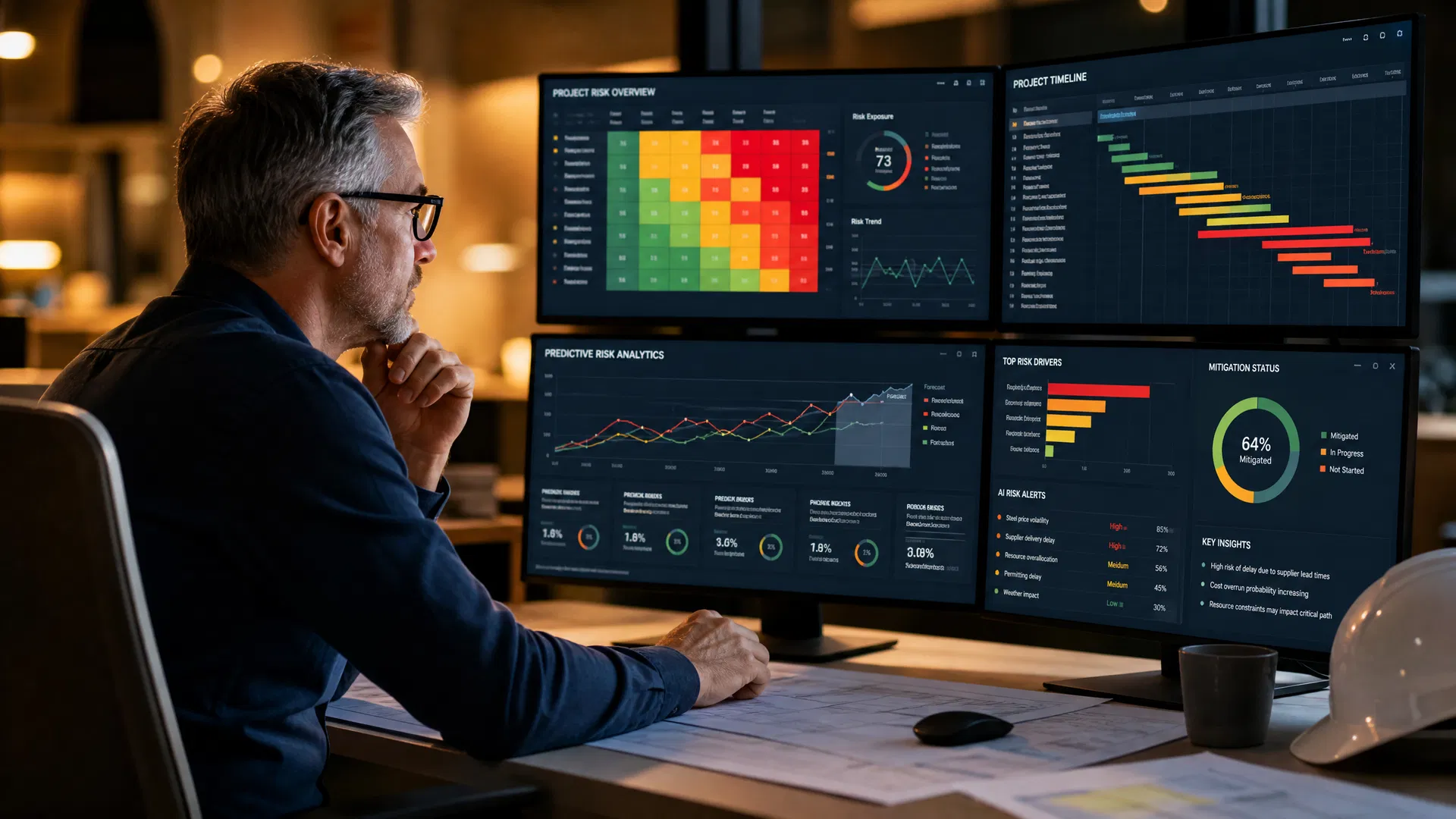
The conventional approach to risk management in engineering projects is fundamentally reactive. Risks are identified in workshops, logged in registers, assigned owners, and reviewed in monthly meetings. By the time a risk escalates to a crisis, the project team is already in damage-control mode — managing consequences rather than preventing them. AI-powered risk detection changes the temporal relationship between risk identification and risk materialisation, surfacing early warning signals weeks before they become project-threatening events.
The Limits of Conventional Risk Management
Traditional risk registers are point-in-time documents. They capture the risks that were identified in a workshop on a specific date, assessed by the people who were in the room, and updated whenever someone remembers to do so. In fast-moving engineering projects, this approach is structurally inadequate. The conditions that create risk — subcontractor performance, design changes, procurement delays, resource constraints — evolve continuously. A risk register updated monthly cannot track a risk environment that changes daily.
The result is a well-documented gap between the risks that appear in project registers and the issues that actually materialise. Post-project reviews consistently reveal that the root causes of major project problems were visible in the data weeks or months before they became crises — but no one was looking at the right signals at the right time.
Research Finding
Analysis of 200+ engineering project post-mortems found that 67% of project crises had detectable early warning signals in project data at least three weeks before the crisis point. The signals were present — the systems to detect them were not.
What Predictive Risk Detection Looks At
Schedule Performance Patterns
Schedule slippage rarely arrives without warning. Before a milestone is missed, there are typically weeks of declining progress rates, increasing variance between planned and actual completion, and growing backlogs of incomplete predecessor activities. AI systems that monitor schedule performance data continuously can identify these deteriorating patterns and flag them as risk indicators long before they translate into programme delays.
Subcontractor and Supplier Signals
Subcontractor performance issues are among the most common causes of engineering project delays. AI systems can monitor a range of leading indicators: response time to RFIs and submittals, frequency of change order requests, pattern of site attendance, and quality of progress reporting. Deteriorating performance across multiple indicators simultaneously is a reliable predictor of a subcontractor in difficulty — typically visible three to five weeks before a formal performance issue is raised.
Document and Communication Patterns
The volume and nature of project communications contain rich risk signals. Increasing frequency of design queries, rising numbers of RFIs on a specific package, or a sudden increase in email traffic between particular parties often indicates an emerging technical or commercial issue. AI systems trained on historical project data can identify these communication patterns as risk precursors.
Resource and Cost Variance
Early cost overruns on individual work packages are strong predictors of overall project cost performance. AI systems that monitor cost performance at a granular level — tracking earned value, burn rate, and forecast at completion by package — can identify packages at risk of overrun weeks before they appear in monthly cost reports.
From Detection to Action
Predictive risk detection is only valuable if it drives action. The most effective implementations connect risk signals directly to decision-making workflows: when a risk indicator crosses a defined threshold, the relevant project manager receives a structured alert with the supporting data, the potential impact, and a recommended response. This closes the loop between detection and mitigation in a way that passive risk registers cannot.
The shift from reactive to predictive risk management does not eliminate project risk — engineering projects will always carry inherent uncertainty. What it does is change the window for response. Three to six weeks of additional lead time on a risk that would otherwise materialise as a crisis is the difference between managed mitigation and emergency response. In project economics, that difference is measured in millions.
Kumash Shah
Principal Consultant, Kresto Consulting
Kumash Shah is a Principal Consultant at Kresto Consulting, specialising in AI workflow transformation for project-based companies. With experience across EPC, infrastructure, and engineering environments, he helps organisations identify and implement practical AI solutions that drive measurable operational improvement.
Get More Insights
Practical perspectives on AI workflow transformation, delivered to your inbox.
Start the transformation.
Run the Workflow Intelligence Assessment to discuss how these insights apply to your specific operations.
Request a Workflow Review ↗