Why Document Intelligence Matters for EPC Companies
Editorial note: this article provides operational guidance. Examples and planning signals must be validated against your organisation’s own data, controls, and delivery context; they are not a promise of client outcomes.
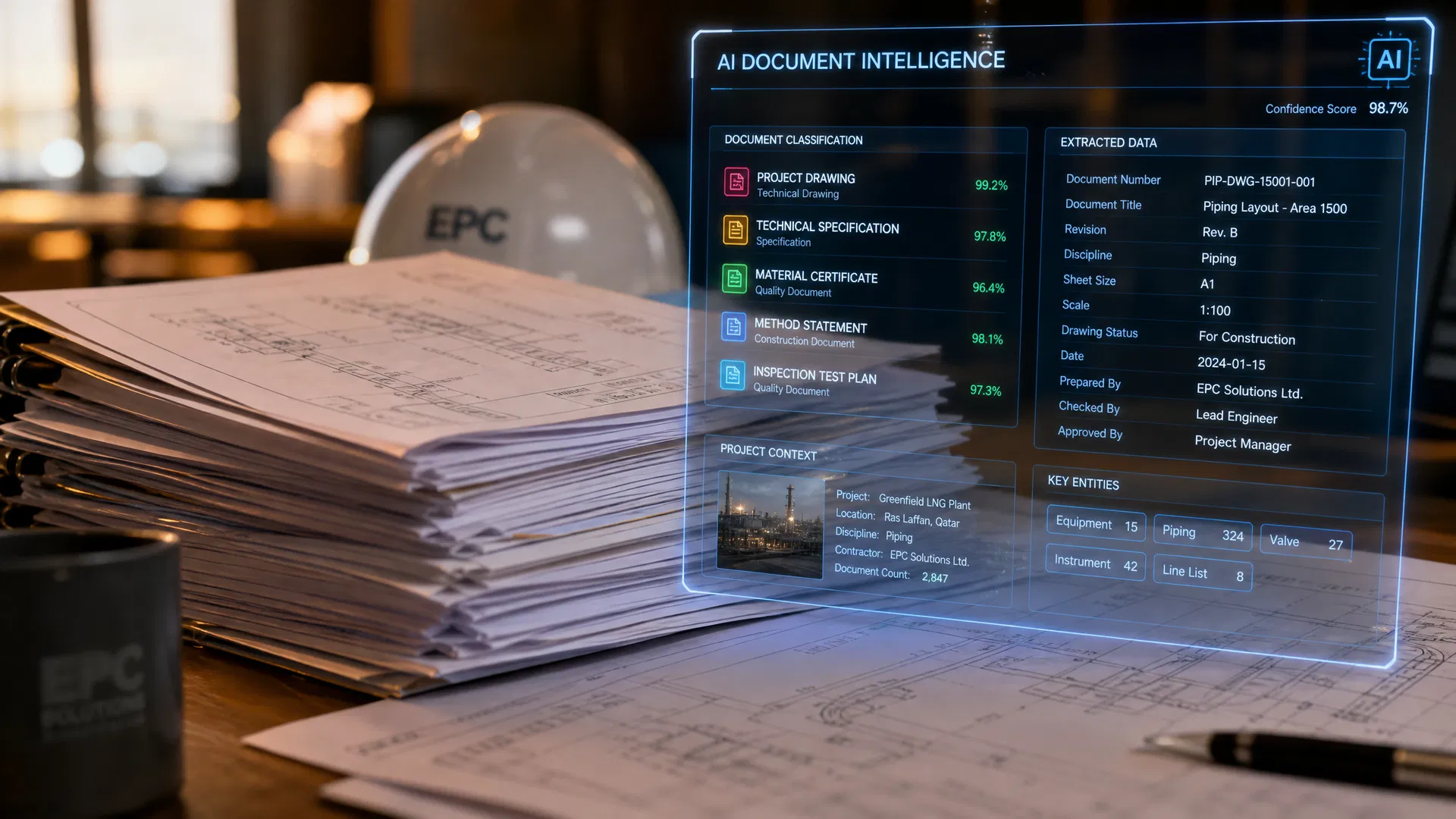
EPC projects generate documents at a scale that most organisations are structurally unprepared to manage. A mid-sized infrastructure project will accumulate thousands of technical specifications, design drawings, contracts, bills of quantities, change orders, RFIs, submittals, inspection reports, and compliance documents over its lifecycle. Finding specific information within this volume is a manual, time-consuming process that consumes engineering and management time, introduces compliance risk, and slows decision-making at precisely the moments when speed matters most.
The Real Cost of Manual Document Management
The direct cost of manual document management is measured in hours — the hours engineers spend searching for a specification, the hours project managers spend locating a change order, the hours compliance teams spend reconstructing document trails for audits. But the indirect costs are often larger and harder to see. Decisions get delayed because the right information is not immediately accessible. Duplicate work gets done because teams cannot find previous analysis. Institutional knowledge walks out the door when experienced team members leave, because that knowledge was never captured in a retrievable form.
In EPC environments specifically, the compliance dimension adds a further layer of risk. Documents that are misclassified, misfiled, or simply lost create audit exposure that can be costly to remediate. A document intelligence system that automatically classifies documents by type, project, phase, and retention requirement eliminates this risk at the point of ingestion rather than discovering it during an audit.
Common Scenario
A site engineer needs the latest revision of a technical specification for a structural element. The document exists — it was issued three weeks ago — but it is buried in a shared drive folder alongside 847 other files. The engineer spends forty-five minutes searching before calling the document controller. This scenario plays out dozens of times per week on a typical EPC project.
What Document Intelligence Actually Does
Document intelligence is not a filing system. It is an active layer of AI capability that sits on top of your document repository and transforms it from a passive storage location into a queryable knowledge base. The distinction matters because it changes what is possible.
Automatic Extraction
A document intelligence system reads incoming documents and automatically extracts structured data from them. From a contract, it extracts payment terms, milestone dates, deliverable requirements, and penalty clauses. From a bill of quantities, it extracts line items, quantities, rates, and totals. From a technical specification, it extracts material requirements, design parameters, and compliance references. This extraction happens at ingestion — the moment a document enters the system — not when someone needs the information.
Intelligent Classification
Every document is automatically classified by type, project, phase, compliance category, and retention period. Documents requiring action — submittals awaiting approval, RFIs requiring response, change orders pending sign-off — are flagged and routed to the appropriate person. The classification is not perfect on day one, but it improves continuously as the system learns from corrections and feedback.
Semantic Search
The most transformative capability is semantic search — the ability to find documents using natural language queries rather than exact filename matches. An engineer can ask "show me all specifications for HVAC systems on the northern block" and receive a ranked list of relevant documents, even if none of them contain those exact words. This is qualitatively different from a keyword search and it is the capability that most dramatically changes how teams interact with their document library.
Institutional Knowledge Preservation
Over time, a document intelligence system becomes a searchable repository of everything the organisation has ever produced — past project documents, lessons learned, technical precedents, and best practices. New team members can find relevant precedents in minutes rather than weeks. The knowledge that previously lived in the heads of experienced engineers becomes accessible to everyone on the team.
Implementation for EPC Environments
Implementation follows a six-phase approach. The first phase is a document inventory — cataloguing document types, volumes, storage locations, and current retrieval challenges. This phase typically reveals that documents are stored in more places than anyone realised, and that the classification schemes in use are inconsistent across projects.
The second phase is extraction design — defining exactly what data points should be extracted from each document type and establishing the validation rules that determine when extraction results require human review. This phase requires input from the people who use the documents, not just the IT team. The engineers who read specifications know what matters in a specification. The contracts team knows what matters in a contract.
Phases three through six cover AI training, system integration, search infrastructure build-out, and governance — the policies and processes that determine how the system is maintained, how extraction accuracy is monitored, and how the document library is kept current as new projects begin and old ones close.
Where to Start
The right starting point is the document type that causes the most pain today. If contracts are scattered across email threads and shared drives, start there. If technical specifications are hard to find and frequently out of date, start there. If change order tracking is a manual nightmare, start there.
Starting small is not a compromise — it is a strategy. A focused first implementation that delivers clear, measurable value in one area builds the organisational confidence and technical foundation needed to expand to other document types. Most EPC companies can implement basic document intelligence within two to three months and see immediate productivity gains that justify the investment many times over.
Kumash Shah
Principal Consultant, Kresto Consulting
Kumash Shah is a Principal Consultant at Kresto Consulting, specialising in AI workflow transformation for project-based companies. With experience across EPC, infrastructure, and engineering environments, he helps organisations identify and implement practical AI solutions that drive measurable operational improvement.
Get More Insights
Practical perspectives on AI workflow transformation, delivered to your inbox.
Start the transformation.
Run the Workflow Intelligence Assessment to discuss how these insights apply to your specific operations.
Request a Workflow Review ↗