Workflow Automation Guide: Document-Control Triage for EPC Teams
Editorial note: this article provides operational guidance. Examples and planning signals must be validated against your organisation’s own data, controls, and delivery context; they are not a promise of client outcomes.
This is a workflow automation guide, not a client case study. It describes an illustrative operating pattern for project-based teams. It does not represent a client engagement, a guaranteed outcome, or a published performance claim.
Where document control becomes a delivery bottleneck
Project teams rarely struggle because a single document is difficult to process. The drag appears when drawings, RFIs, submittals, correspondence, and revisions arrive through several channels with inconsistent naming, missing context, and unclear ownership. The result is manual triage, avoidable routing delays, and weak auditability.
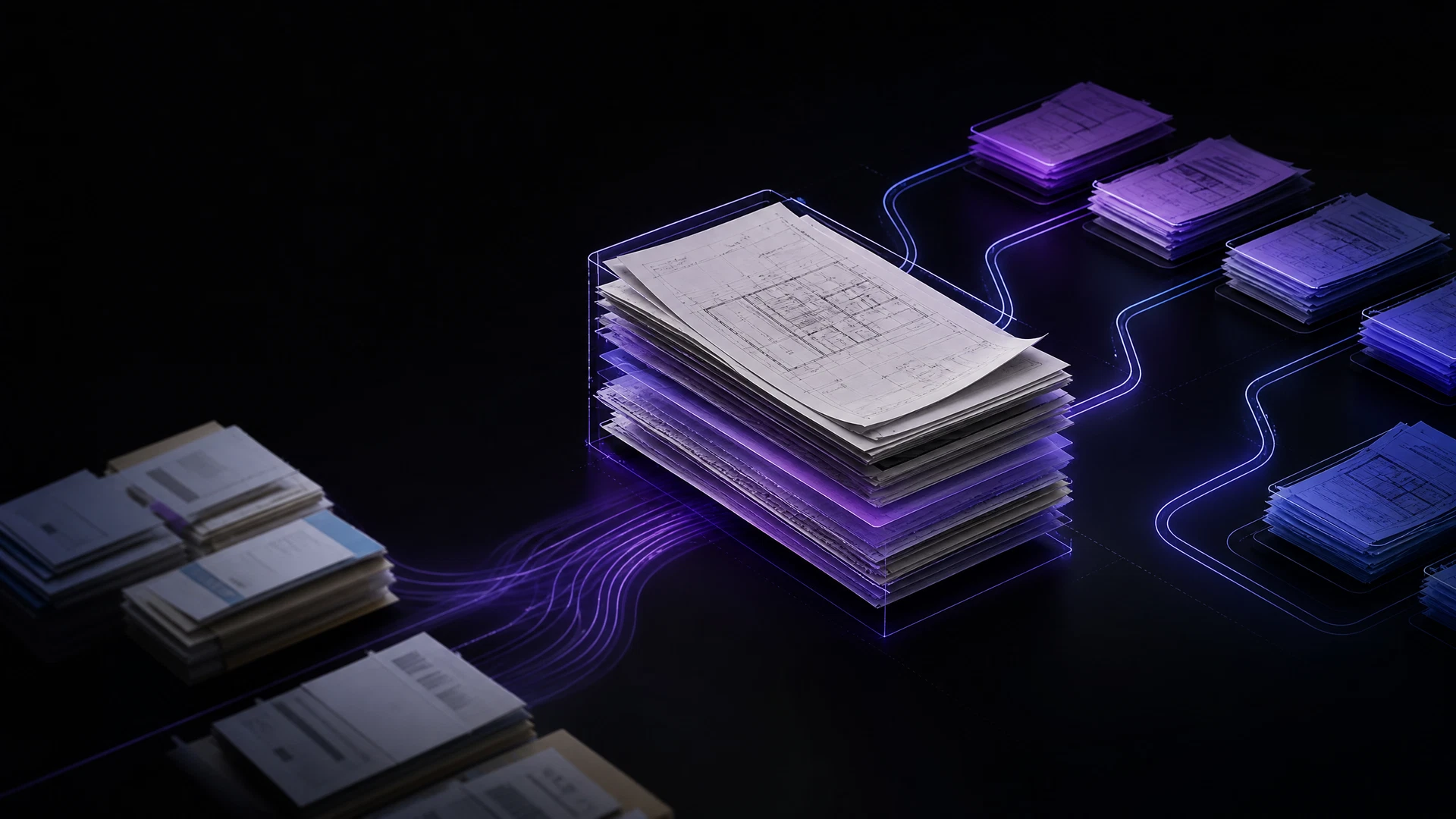
The operating pattern
- Controlled intake: Bring approved inboxes, shared folders, and project platforms into a defined intake queue while preserving the source, timestamp, project reference, and original file.
- Classification with confidence rules: Extract standard metadata such as document type, discipline, package, revision signal, and sender. Low-confidence classifications move to a human review queue instead of being silently routed.
- Rules-based routing: Match the document to the responsible role, workflow stage, and response expectation. Existing document-control rules remain the governing logic.
- Exception management: Surface duplicates, incomplete submissions, conflicting revisions, and overdue reviews as visible exceptions for an accountable owner.
- Audit-ready handoff: Store the routing decision, reviewer action, and final destination so the process can be inspected later.
What automation should not decide alone
Contractual interpretation, design approval, safety-critical decisions, and ambiguous revision conflicts should remain with accountable people. The practical role of automation is to reduce sorting and follow-up work, not to remove engineering judgement or bypass established governance.
How to start without disrupting delivery
Begin with one repeatable document family, one project platform, and a small group of named reviewers. Define the exception path before expanding scope. A contained launch creates a usable baseline for accuracy, response time, rework signals, and reviewer workload.
What to measure before scaling
Measure intake-to-routing time, manual touches per item, confidence-review rate, exception resolution time, overdue review volume, and routing corrections. These measures tell the team whether the workflow is reducing coordination overhead without weakening document control.
A practical next step
A Workflow Intelligence Assessment can map the current intake path, identify where decisions actually stall, and define the smallest controlled automation opportunity worth implementing first.
Kresto Consulting
Workflow Transformation Team, Kresto Consulting
Kumash Shah is a Principal Consultant at Kresto Consulting, specialising in AI workflow transformation for project-based companies.
Get More Insights
Practical perspectives on AI workflow transformation, delivered to your inbox.
Start the transformation.
Run the Workflow Intelligence Assessment to discuss how these insights apply to your specific operations.
Request a Workflow Review ↗